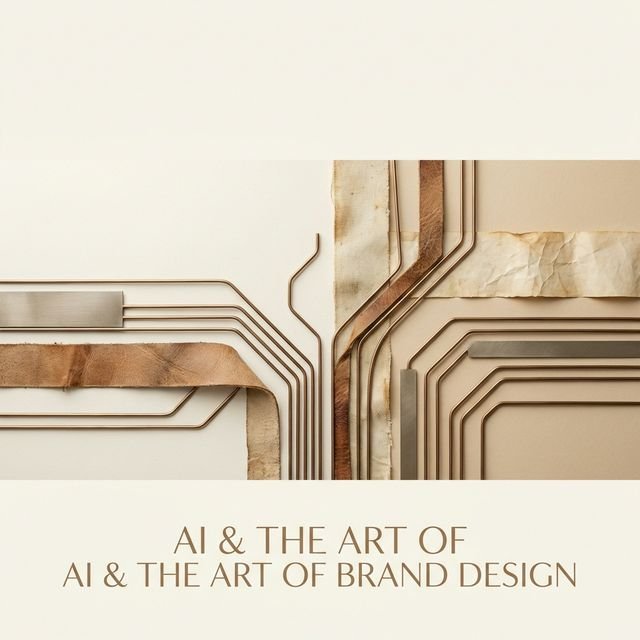
In an era where artificial intelligence is revolutionizing industries at an unprecedented pace, the creative sector finds itself at a fascinating crossroads. The question is no longer whether AI will impact brand design, but rather how we can harness its capabilities while preserving the irreplaceable human elements that make branding truly exceptional.
The Dawn of a New Creative Era
The integration of AI into brand design represents one of the most significant shifts in the creative industry since the digital revolution. Tools powered by machine learning and neural networks can now generate logos, color palettes, and even entire brand identities in seconds. For creative agencies and brand consultancies, this technological leap presents both unprecedented opportunities and profound challenges.
At Loiste Studio, we've witnessed firsthand how AI tools have transformed our workflow. What once required days of iterative sketching and refinement can now be accomplished in hours. AI-powered design assistants can analyze thousands of successful brands, identify patterns, and suggest combinations that a human designer might never considerIt's tempting to view this efficiency as a threat to the craft, but we see it differently.
AI doesn't replace creativity—it amplifies it. The designer's role evolves from executor to conductor, orchestrating technology and intuition into harmonious brand experiences.
The Human Touch: Irreplaceable and Essential
While AI excels at pattern recognition, data analysis, and rapid iteration, it fundamentally lacks the emotional intelligence, cultural understanding, and nuanced judgment that define exceptional brand design. A brand is not merely a visual identity—it's a living entity that embodies values, tells stories, and forges emotional connections with its audience.
Consider the strategic decisions that precede any visual work: understanding a client's vision, interpreting market positioning, recognizing cultural sensitivities, and translating abstract business objectives into tangible creative directions. These require empathy, experience, and intuition—qualities that remain distinctly human.
Where AI Assists, Humans Excel
Our approach at Loiste Studio leverages AI as a powerful assistant rather than a replacement. We use generative algorithms to explore vast design possibilities quickly, identifying promising directions that our designers then refine with human judgment. AI handles the computational heavy lifting—analyzing color theory, ensuring accessibility compliance, optimizing for various digital platforms—while our creative team focuses on strategy, storytelling, and emotional resonance.
This symbiotic relationship has proven transformative. In a recent project for a luxury hospitality brand, AI tools helped us generate hundreds of monogram variations in minutes. However, it was our designers' understanding of elegance, restraint, and the client's heritage that selectedthe single option that perfectly captured the brand's essence.
Navigating the Challenges of AI Integration
The path to AI-enhanced creativity is not without obstacles. One significant challenge is maintaining originality in an age of algorithmic design. When AI tools train on existing work, there's a risk of homogenization—brands begin to look similar because they're derived from the same data sets and algorithmic principles.
We address this by using AI as a starting point, never an endpoint. The initial AI-generated concepts serve as a foundation for human creativity to build upon, transform, and elevate. We also prioritize proprietary data sets and custom training models that reflect our unique design philosophy rather than generic industry trends.
Ethical Considerations in AI-Driven Design
Beyond aesthetics, AI in brand design raises important ethical questions. Who owns the copyright to AI-generated designs? How do we ensure that AI tools don't perpetuate biases present in their training data? What happens to junior designers when entry-level tasks become automated?
At Loiste Studio, we've established clear guidelines: AI-generated work is treated as a tool-assisted creation, similar to using Photoshop or Illustrator. Our designers remain the authors and decision-makers. We actively audit our AI tools for bias and ensure diverse data sets. And we've redefined junior roles to focus on strategic thinking and creative problem-solving rather than purely executional tasks.
The Future: Collaboration Over Competition
Looking ahead, the most successful brand design studios won't be those that resist AI or those that rely on it entirely. They'll be the ones that master the collaboration between human creativity and artificial intelligence, leveraging each for what it does best.
We envision a future where AI handles real-time brand adaptation—automatically adjusting visual elements for different platforms, audiences, and contexts while maintaining brand consistency. Meanwhile, human designers focus on high-level strategy, narrative development, and the emotional architecture that makes brands memorable and meaningful.
Preparing for Tomorrow's Brand Design
For brands and businesses, the key is partnering with agencies that understand this balance. Look for creative partners who demonstrate proficiency with AI tools but emphasize human-centered design thinking. Ask about their process: How do they use AI? What decisions remain human-driven? How do they ensure your brand remains unique and authentic?
The brands that will thrive in this AI-augmented future are those that embrace technology as an enabler while recognizing that true brand excellence stems from human insight, cultural awareness, and emotional intelligence.
Conclusion: A Renaissance, Not a Replacement
AI-driven creativity represents a renaissance for brand design—a period of expanded possibilities and elevated craftsmanship. Just as the printing press didn't eliminate writers or digital photography didn't erase photographers, AI won't replace designers. Instead, it redefines what design can be and what designers can accomplish.
At Loiste Studio, we're excited by this evolution. We see AI as a powerful tool that frees us from tedious tasks, accelerates exploration, and expands creative possibilities—allowing us to focus more energy on what we do best: understanding brands deeply, crafting compelling narratives, and creating visual identities that resonate on a profoundly human level.
The future of brand design isn't artificial intelligence versus human creativity. It's artificial intelligence plus human creativity—a partnership that promises to elevate branding to unprecedented heights.